How it works
Six steps in My Claim. What’s Next, your progress, and your deadlines stay in view.
How it works
Start
Open My Claim and name what you are working on. What’s Next is on the page.
Requirements
Read what a claim like this asks for, in plain words, from the VA pages we cite.
Evidence
Sort records you already have. Missing stays missing. Unknown stays unknown.
Build
Keep evidence, your words, and the right forms together. You write the statement. We ask about a detail the rating rules mention.
Schedule
Stay on schedule. The clock starts when you file a notice, not when you open this site. Add dates you already have.
Review and file
Review what you built. You or an accredited representative file on an official VA channel.
The workbench
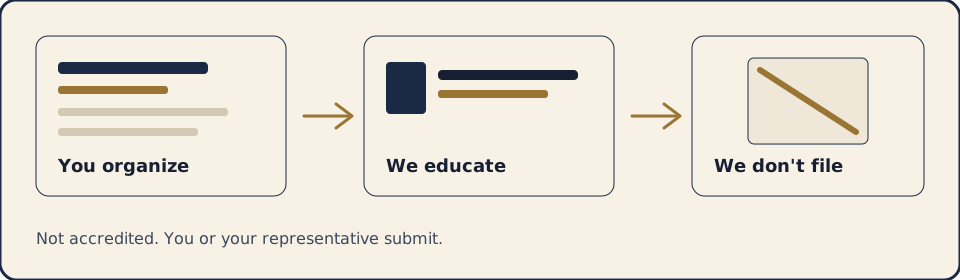
The shipped core is My Records, Ask My Records, Timeline, Record Map, and My Claim. Decision Letter Explainer and Privacy Center sit with it. You prepare your own claim. We do not file. The walkthrough is a fictional sample, not a C-file.
- My Records — Your files, or an empty vault. We do not download a C-file from VA.
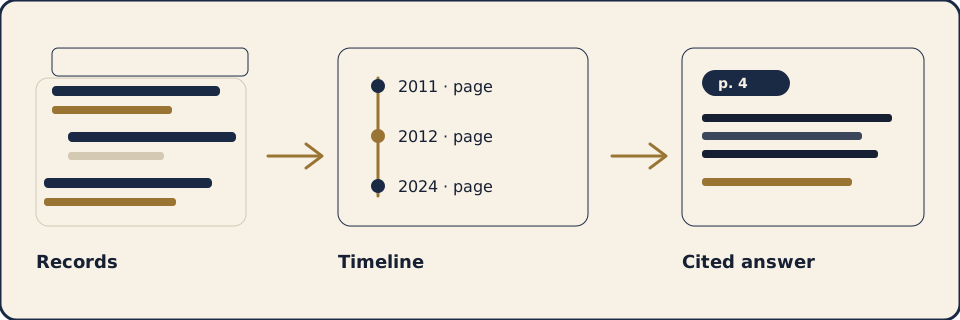
- Ask My Records — A quote appears only when those exact words are on the page. No match, no quote.
- Timeline — A date only when the page writes one.
- Record Map — Unknown stays Unknown. A stored class is not a VA finding.
- Decision Letter Explainer — Records and one published rule, kept apart — not a rating, not a payment.
- Privacy Center — What this account stores, plus export or delete.
How you assemble the claim
We break down the rules and the links between conditions. You file it yourself. We do not diagnose, invent symptoms, prescribe a nexus letter, or file.
- Download medical records yourself: branch medical system, every private health system, and telehealth. We do not pull them from VA.gov or those portals.
- Send all of them to VA with the claim. Upload copies here only if you want.
- Personal statement and witness statements, in your words. If a criteria detail is missing, the review asks a plain question. It does not invent the fact.
- Published criteria, in one place and in plain words. Migraines are the example: how often, how long, and whether an attack stops ordinary activity. Snoring is not the same as being constantly tired during the day. Only if that is true for you. Those quotes are dated and reviewed on a schedule.
- Secondary conditions you may also have. Possible added claims, not a diagnosis.
- The right forms for the claim type, such as VA Form 21-0781 for PTSD. You fill them out. We do not submit. Traumatic brain injury has no separate form on VA’s additional-forms page, so we do not invent one.
Migraine example · PTSD forms · TBI forms · claims file · VA C-file
Read a short guide. You file the notice. Stay on schedule. Sort records you already have.
Notice of a claim · Stay on schedule · Fully developed claim checklist · Learn library
Optional while you assemble: copies you already have
C-file
Copies you already have. The guide shows how to request one yourself, then upload it here if you want.
Ask My Records
A quote appears only when those exact words are on the page.
Timeline
A date only when the page writes one.
Record Map
Sections already in the index. Unknown stays Unknown.
Decision Letter Explainer
Read your letter next to one published rule.
Click through My Records, Ask, Timeline, Record Map, and the Explainer
Fiction · sample only · not a real veteran · not a C-file · not your records · we do not file
This walkthrough is a fictional sample, not a real veteran and not a C-file. Nothing is stored. You prepare your own claim. We do not file.
You prepare your own claim. We organize and educate. We do not file. Not an accredited representative. Never a percentage of VA pay. We do not invent a diagnosis or an outcome.